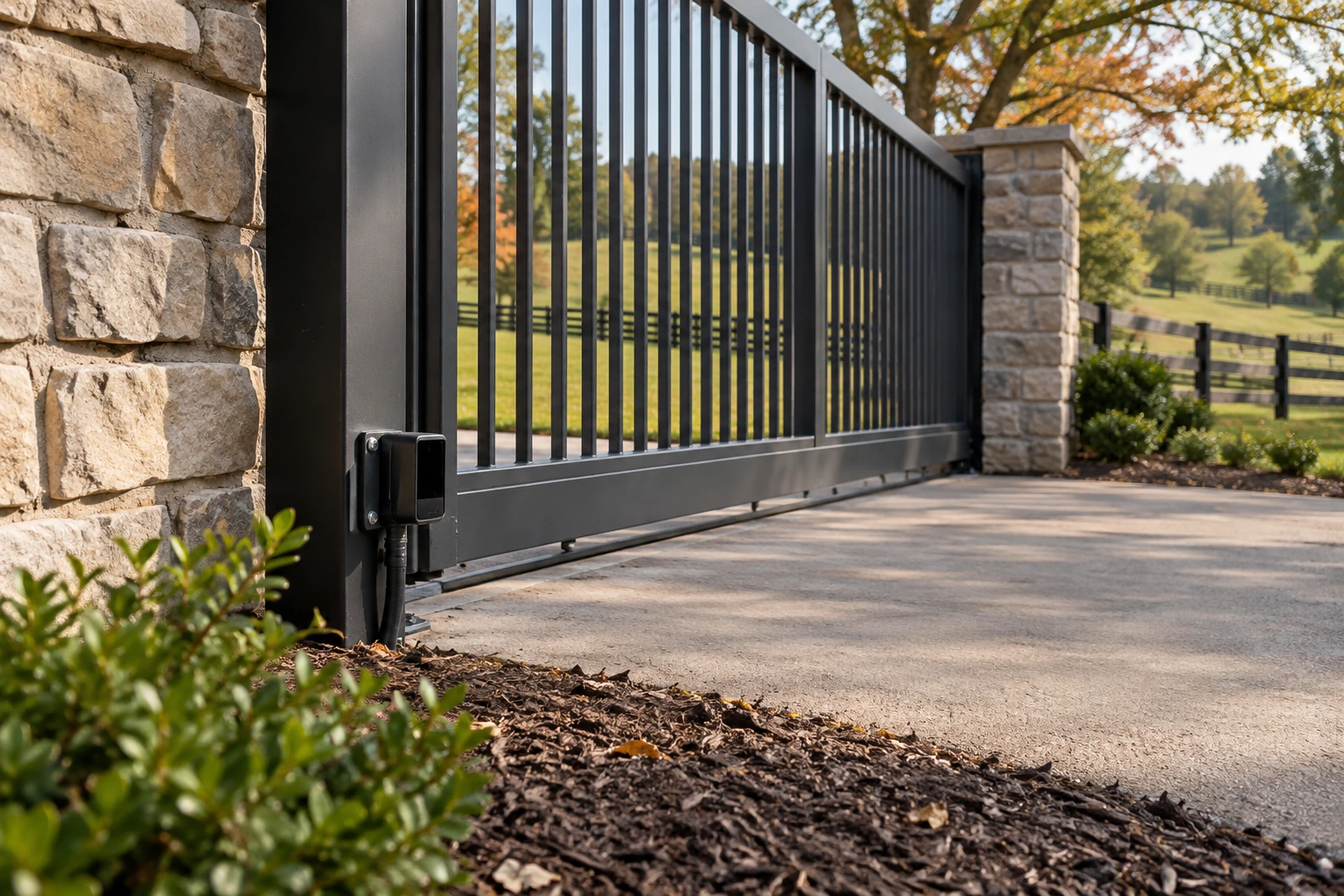
Metal Gate Sensor & Safety Equipment Installation in Lexington, KY | Photoelectric eyes and safety edges providing entrapment protection
We are Lexington KY Metal Gates, and we build and install metal Gate Sensor & Safety Equipment Installation across Lexington and the Bluegrass, and we would rather explain how the job actually gets done than promise you a number before we have seen the site. That starts with the footer and the soil, not the steel you see above ground. We would rather walk you through the whole job now than have you find out the hard way what a shortcut costs later.
Metal Gate Sensor & Safety Equipment Installation in and around Lexington KY
An automated gate is a piece of life-safety equipment as much as it is a convenience feature, which is why the industry has two separate standards governing it: UL 325 for the operator, and ASTM F2200 for the gate itself. We build to both, not because a customer asked, but because a gate that can pin a car door or a child against a post is not a gate we are willing to sell.
This sits alongside the rest of the systems work we do at Lexington KY Metal Gates.
Our Four-Step Process
Site inspection
We assess power availability, traffic pattern, and the gate's weight and swing or slide path.
Operator and safety design
We select the operator and specify at least 2 entrapment protection devices for the install.
Installation and wiring
Operator, sensors, and access control are installed and wired to a weatherproof enclosure.
Testing per UL 325 and ASTM F2200
We test entrapment protection, force settings, and manual release before handoff.
How We Build It, and How It Usually Gets Built
Exit loops open the gate for outbound traffic, shadow loops keep the gate from closing on a vehicle sitting in the swing path, and safety loops reverse the gate if something is in the way. Which combination you need depends on traffic pattern, not just gate type.
We will say plainly if a job is not worth doing the way it is being asked. A repair that only delays a foundation problem by a season is not a repair we want our name on.
What Drives the Cost
We do not publish flat prices because two gates that look alike on paper can be very different jobs once we are on site. These are the factors that actually move the number.
Gate size and material
A wider or heavier leaf needs a larger footer, heavier hardware, and in some cases a stronger operator, all of which affect the job.
Site conditions
Shallow limestone, an existing failed footer that has to be removed, or a slope at the entrance all add time that a flat, clear site would not need.
Automation and access technology
A manual gate is a different scope than a gate with an operator, sensors, a keypad, and an intercom wired together.
What This Job Actually Involves
- Operator sized to the gate's weight, wind load, and duty cycle
- Two independent entrapment protection devices per UL 325, on every direction of travel that has an entrapment risk
- Entrapment zones between 4 and 16 inches identified and guarded per ASTM F2200
- Access control and safety devices wired and tested together, not treated as separate add-ons
Everything We Build in the Bluegrass
UL 325 entrapment protection
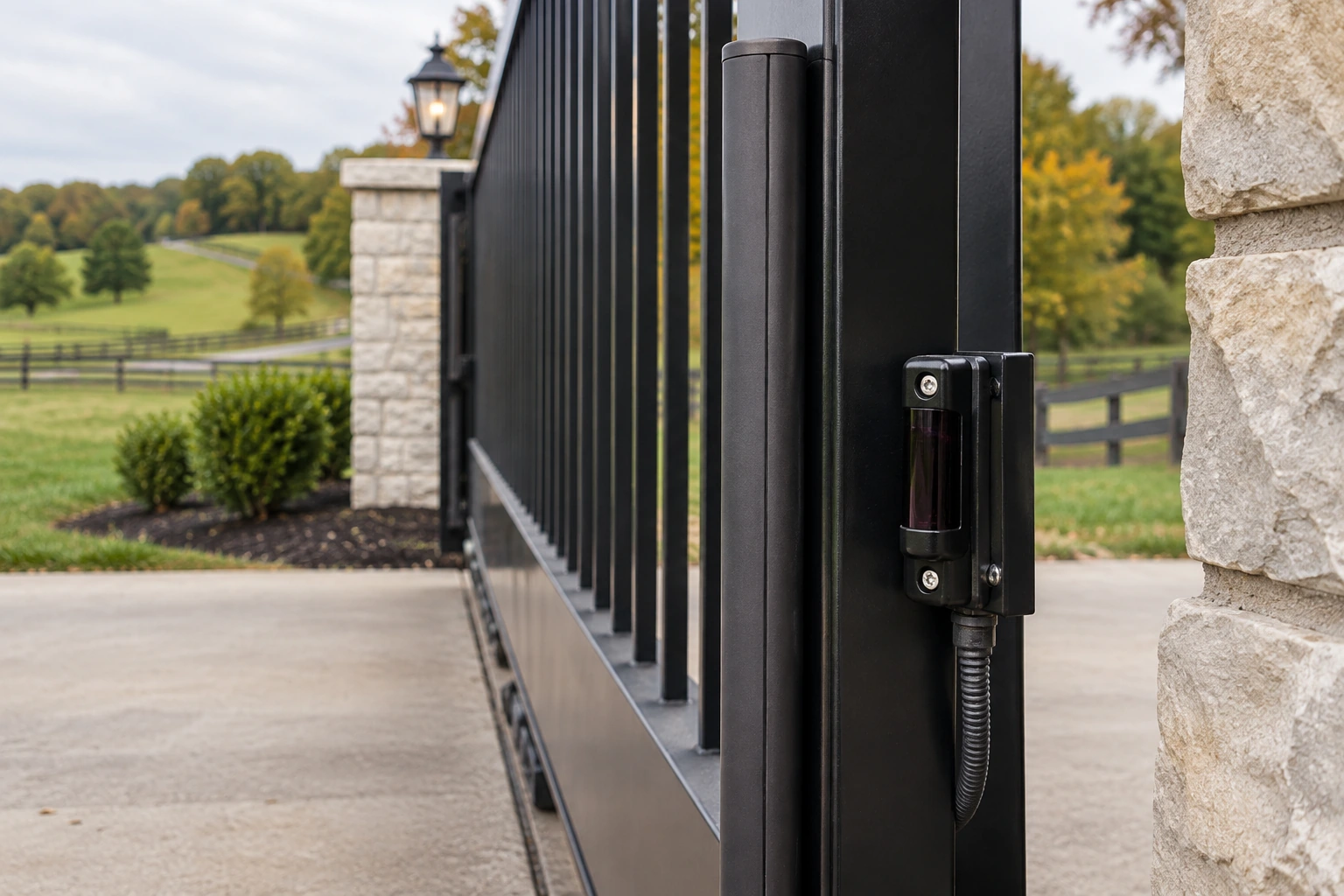
An automated gate operator needs at least 2 independent entrapment protection devices, typically inherent force sensing built into the motor plus a non-contact photoelectric eye or a contact safety edge.
ASTM F2200 construction rules
Any gap in the gate's structure between 4 and 16 inches counts as an entrapment zone and has to be guarded. Slide gates and their adjacent fence cannot allow a 2.25-inch sphere through up to 48 inches above grade, and exposed rollers below 8 feet need covers.
Vehicle detection loops
Exit loops open the gate for outbound traffic, shadow loops keep the gate from closing on a vehicle sitting in the swing path, and safety loops reverse the gate if something is in the way. Which combination you need depends on traffic pattern, not just gate type.
Access technology
Keypads, Wiegand-protocol card readers, cellular video intercoms, RFID windshield tags, and Knox Box fire department access are not interchangeable. Commercial and gated-community sites usually need more than one.
Usual vs. Us
How it's often done
- A single sensor, or none, treated as sufficient entrapment protection
- Operator sized by what was on the truck, not the gate's actual load
- Access technology bolted on without integration testing
How we do it
- At least 2 independent entrapment protection devices on every at-risk direction of travel
- Operator selected for the gate's measured weight, wind load, and duty cycle
- Every access device tested together before we call the job done
Before We Arrive
- Confirm power is available near the gate location, or ask us about solar
- Decide who needs day-to-day access: family, staff, delivery drivers, guests
- Note any local ordinance on gate setback from the street or right-of-way
- Tell us if emergency responders will need Knox Box or other rapid access
What Goes Wrong
| Symptom | Likely Cause | What We Do |
|---|---|---|
| Gate reverses unexpectedly for no obvious reason | A misaligned or dirty photoelectric sensor triggering a false entrapment signal | Clean and re-align the sensor pair, then verify force settings on the operator |
| Gate will not open with the remote but the keypad works | Failed receiver or a corrupted code in the operator's memory, not usually the remote itself | Test the receiver directly before replacing hardware that already works |
| Vehicle waits at the loop and the gate does not respond | Loop wire damaged by pavement settling or cut during unrelated utility work | Trace the loop circuit, locate the break, and re-cut rather than guessing at a full loop replacement |
Specification Plate
- Standards
- Built to UL 325 (operator) and ASTM F2200 (gate construction)
- Entrapment protection
- Minimum 2 independent devices per at-risk direction
- Operator types
- Linear actuator, articulated arm, slide, or underground, matched to gate style
- Access options
- Keypad, intercom, RFID tag, remote, or Knox Box for emergency access
Frequently Asked Questions
Cost depends on gate size, material, site conditions, and whether the gate is automated, so we do not quote a figure without seeing the opening. Call Lexington and the Bluegrass area jobs in for a free, no-obligation quote and we will walk you through what drives the number for your specific site.
A straightforward manual gate is often a one to two day job once the footer concrete has cured enough to bear load. Adding automation, access control, or unusual site conditions like shallow limestone extends that. We will give you a real schedule after the site visit, not a generic estimate.
You do not need to be present for the full job, but we do ask that someone is available at the start to confirm gate location, swing or slide direction, and any property lines or utilities we should know about.
Yes. We walk the site, look at what we are working with, and give you a written quote with no obligation and no pressure to sign that day.
When installed to UL 325 and ASTM F2200, yes. That means at least 2 independent entrapment protection devices and no unguarded gap between 4 and 16 inches anywhere the gate moves.
Most residential operators we install include a battery backup rated for a number of cycles after an outage, and nearly all can be released to swing or slide manually with a key or release lever.
It depends on the jurisdiction and the height and location of the gate. Fayette County caps front yard fences and gates at 4 feet and side or rear yard structures at 8 feet, with different rules for gates on a public right-of-way. We check the applicable code for your address before we build so there are no surprises at inspection.
Adding a gate, especially an automated one with safety sensors, is generally viewed favorably by insurers, though you should confirm with your specific carrier since policies vary.
Yes, though concrete cure times run longer in cold weather and we plan the schedule around that rather than rushing a footer that has not properly set.
Talk to Us About Metal Gate Sensor & Safety Equipment Installation
Free, no-obligation quotes for metal gate sensor & safety equipment installation across Lexington and the Bluegrass.
Call 859-800-6978