How Deep Should a Metal Gate Post Footer Be in Kentucky?
A Fayette County and Bluegrass-specific technical explainer, checked against primary sources.
We are Lexington KY Metal Gates, and this guide reflects how we actually build and repair gates across the region. This is the single most misquoted number in the metal gate trade, and it is worth getting right because a gate post that is set too shallow does not fail quickly. It fails slowly, over several winters, as clay and frost work the post loose a fraction of an inch at a time.
The 15-inch figure and what it actually means
You will see "Kentucky's frost line is 15 inches" repeated across contractor websites and forums, and it is not exactly wrong, it is just answering a different question than the one that matters for a footing. That number describes an estimate of how deep the ground typically freezes in an average Kentucky winter. It is not the legally required depth of a structural footing.
The actual code requirement comes from the Kentucky Residential Code, Table R403.1.4, which sets a Minimum Frost Protection Depth by county. Fayette County, along with the large majority of Kentucky counties, falls under the standard entry of 24 inches. A smaller group of mostly eastern Kentucky counties, including Bell, Boone, Breathitt, Campbell, Clay, Floyd, Harlan, Johnson, Kenton, Knott, Knox, Lawrence, Leslie, Letcher, Magoffin, Martin, Owsley, Perry, and Pike, have deeper minimums of 27 to 33 inches.
Why we still go deeper than the code minimum
Here is the part that gets missed even by people who know the correct 24-inch figure: that number is written for a building foundation, which is backfilled with soil on every side and often protected by the heated structure above it. A gate post is nothing like that. It stands alone, fully exposed on all sides to freeze-thaw cycling, and it has to resist a constant cantilevered load every time the gate swings.
That combination, exposed footing plus lateral swinging load, is why we set heavy metal gate posts at 36 to 48 inches with a bell-shaped base that widens at the bottom. The bell shape resists the upward force of frost heave and gives the concrete more mass to counteract the leverage of a swinging leaf. This is engineering practice, not a code requirement, and it is the difference we see most often between a ten-year-old gate that still closes cleanly and one that is dragging on the pavement.
Karst bedrock adds a second variable
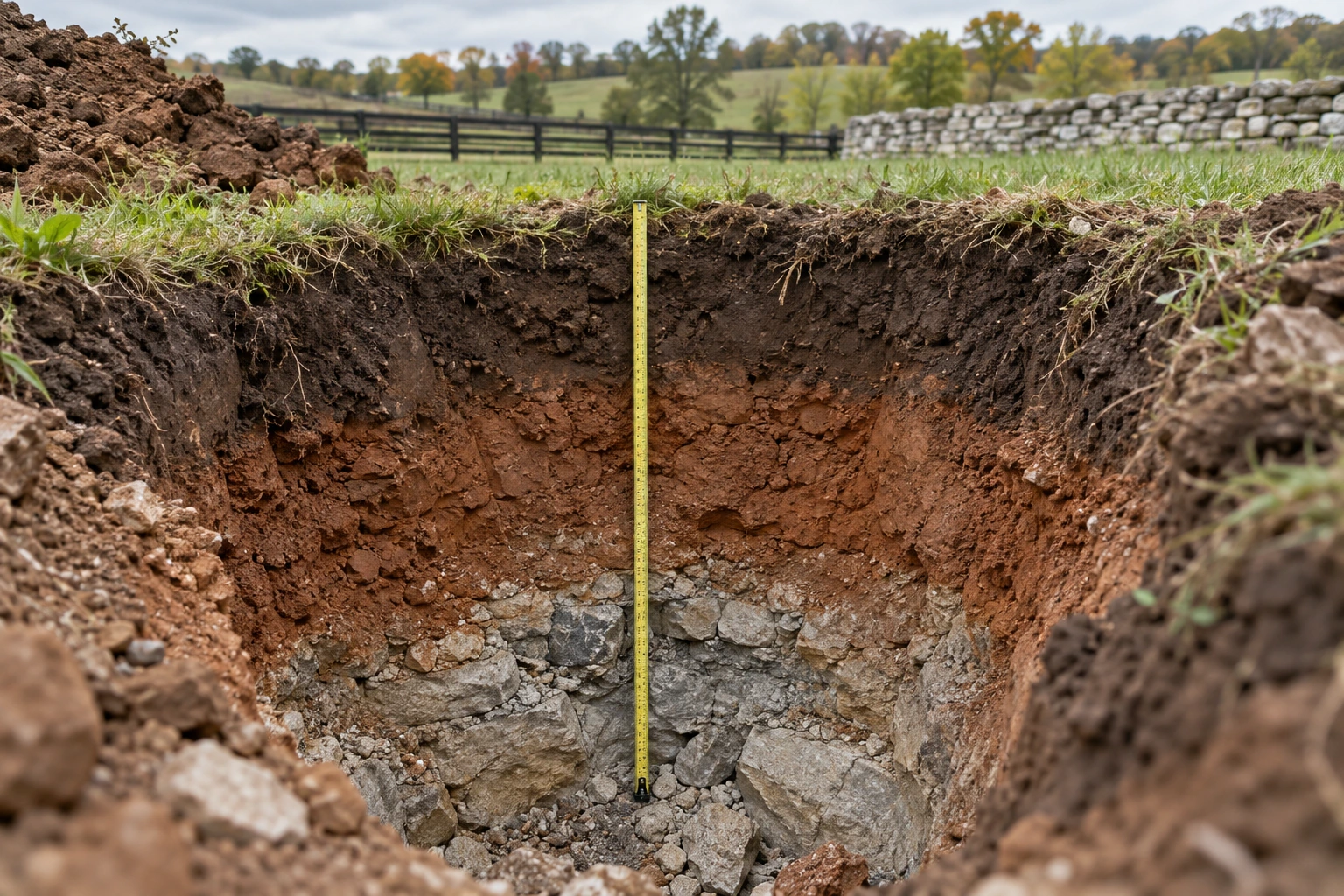
The Inner Bluegrass, including most of Fayette County, sits on karst topography: a landscape shaped by soluble limestone bedrock that often sits much closer to the surface than people expect. On a normal residential lot this usually just means we hit rock before we reach target depth, which changes the equipment from a standard auger to a rock drill or a combination of coring and hand excavation. On rural and estate properties it can also mean sinkholes or void spaces nearby that affect where a gate can be sited at all.
We check for shallow rock during the site visit, not after we start digging, because that changes both the schedule and, honestly, the equipment on the truck that day.
Expansive clay: the other half of the problem
Above the limestone across most of the Bluegrass sits a layer of heavy clay that swells when saturated and shrinks when dry. That seasonal movement is slow but relentless, and a footer without proper drainage gravel at its base can trap water against the concrete, which accelerates the cycle. We place drainage gravel below every footer for exactly this reason, along with high-PSI concrete mixed for the load rather than a bag off the shelf.
| Footing Approach | Depth | Typical Outcome |
|---|---|---|
| Minimum code depth, no bell base | 24 inches | Meets code for a building foundation; often inadequate for a cantilevered gate post in clay |
| Common estimate, undersized | 15 inches | Below even the code minimum; a frequent cause of early leaning |
| Our standard practice | 36–48 inches, bell base | Built for the actual cantilever load and Bluegrass clay movement |
Frequently Asked Questions
Because of Kentucky's 24-inch code minimum frost protection depth and heavy Bluegrass clay, we set metal gate post footers at least 36 to 48 inches deep in high-PSI concrete to resist winter frost heave and long-term sagging.
No. The 15-inch figure describes how deep the ground typically freezes, not the depth a footing legally has to reach. The Kentucky Residential Code sets Fayette County's Minimum Frost Protection Depth at 24 inches under Table R403.1.4, and a freestanding gate post needs to go well beyond even that.
It is written for Lexington and the surrounding Bluegrass counties specifically, using the code sections and technical standards that actually apply here, not a national generic average.
This guide reflects how Lexington KY Metal Gates actually builds and repairs gates in this region, checked against the primary codes and standards it cites.
Yes. If this topic applies to a gate project you are planning, call for a free, no-obligation quote and we will apply what is in this guide to your specific site.
It depends on the specific job and jurisdiction. Fayette County caps front yard fences and gates at 4 feet and side or rear yard structures at 8 feet; other counties in our service area set their own limits. We confirm the applicable rule before any work begins.
It reflects the code sections, standards, and figures current as of our most recent review, cited to their primary sources. Codes and standards do get revised, so we recommend confirming any figure that affects a permit application directly with the issuing authority.
In most cases yes, though a repair that does not change the gate's height, location, or automation status may not trigger the same permit review as new construction. We check this on a case-by-case basis.
Call us directly and we will walk through your specific Lexington property, since every site is a little different.
Have a Project That Touches This?
Call 859-800-6978 for a free, no-obligation quote.
Call 859-800-6978